

Artificial Intelligence (AI) isn’t just for tech giants anymore. In 2026, AI-powered tools are democratizing opportunities, enabling anyone to generate income online—even with zero coding background. From automating repetitive tasks to creating digital products, AI opens doors to side hustles and passive income streams that once required specialized skills.
If you’re curious how to leverage AI for online income, this article delivers practical insights and step-by-step guidance. Whether you want to earn extra cash in your spare time or build a scalable online business, you’ll discover accessible AI income ideas that fit a variety of interests and skill levels.
In the sections ahead, we’ll explore seven beginner-friendly AI money-making methods, share quick-start tips, answer frequently asked questions, and point you to U.S.-based resources. Ready to tap into the digital gold rush? Let’s dive in.

Table of Contents
1. AI Content Creation and Freelance Writing
What it is:
AI content creation uses large language models (LLMs) like ChatGPT or Gemini to generate blog posts, social media copy, and email newsletters. As a freelancer, you refine AI drafts, add your own voice, and deliver polished content to clients.
Why beginners can start:
- No coding needed—just strong writing and editing.
- AI handles research and first drafts, slashing turnaround time.
- Platforms like Upwork and Fiverr have high demand for bulk content.
Practical examples:
- Write product descriptions for e-commerce stores using AI prompts.
- Produce weekly blog posts—feed AI a topic, then edit for clarity.
- Create email drip campaigns: AI suggests subject lines and sequences.
Steps to get started:
- Sign up for a ChatGPT or Gemini subscription.
- Build sample content pieces to showcase your style.
- List services on freelance sites with clear AI-enhanced offerings.
2. AI-Powered Graphic Design and Print-On-Demand
What it is:
AI image generators (Midjourney, DALL·E) create unique artwork, logos, or t-shirt designs. Combined with print-on-demand platforms like Redbubble or Printful, you sell products without inventory.
Why beginners can start:
- No design degree required—just creative prompts.
- Low upfront costs: free or inexpensive AI tools and print services.
- Passive income as products sell 24/7.
Practical examples:
- Generate niche art styles (e.g., retro travel posters) and upload to Etsy.
- Create custom pet portraits: AI renders stylized images, you refine them.
- Design motivational quote prints—AI crafts backgrounds and typography.
Table 1: Print-On-Demand Profit Margins
| Product Type | Base Cost | Average Sell Price | Estimated Profit per Sale |
|---|---|---|---|
| T-Shirt | $12 | $25 | $6–$8 |
| Mug | $8 | $18 | $4–$6 |
| Poster | $5 | $15 | $6–$8 |
| Phone Case | $10 | $22 | $6–$7 |
3. Automated YouTube and Faceless Video Channels
What it is:
Use AI to script, record voiceovers, and edit videos—creating faceless YouTube channels on topics like finance, tech reviews, or meditative animations.
Why beginners can start:
- No on-camera presence required.
- Tools like Descript, Pictory, and ElevenLabs streamline production.
- Ad revenue, sponsorships, and affiliate marketing offer multiple monetization paths.
Practical examples:
- “Top 5 Investment Apps” video: AI drafts script, AI voice reads it, AI edits visuals.
- Meditation channel: AI generates calming visuals and background music.
- Tutorial series: AI produces step-by-step software guides with screen recordings.

Tips for success:
- Focus on evergreen content—topics that drive views over time.
- Add human commentary or analysis to satisfy platform monetization requirements.
- Maintain a regular upload schedule to build audience momentum.
4. AI Chatbots and Virtual Assistant Services
What it is:
Build or customize AI chatbots (using Dialogflow, Botpress, or OpenAI API) for small businesses. Offer 24/7 customer support, lead qualification, or internal knowledge-base assistants.
Why beginners can start:
- Low-code platforms simplify bot creation.
- Recurring revenue from chatbot subscriptions or support packages.
- Immediate value: businesses save on support costs and improve response times.
Practical examples:
- E-commerce bot answers FAQs and processes simple orders.
- Real estate chatbot schedules viewings and captures lead details.
- HR assistant for small firms: answers policy questions and logs requests.
Getting clients:
- Showcase a demo bot on your website.
- Network in small-business Facebook groups or LinkedIn.
- Offer free trials or pilot projects to prove ROI.
5. Building No-Code Micro-SaaS Products
What it is:
Leverage no-code AI platforms (Bubble, Adalo, n8n) and AI APIs to build Micro-SaaS tools—simple web apps that solve niche problems.
Why beginners can start:
- No coding required—drag-and-drop interfaces handle logic.
- Low hosting and maintenance overhead.
- Recurring subscription revenue from a small but loyal user base.
Practical examples:
- Automated invoice generator with AI data extraction.
- Social media post scheduler integrating AI caption suggestions.
- Client intake form that uses AI to categorize inquiries.

Monetization strategies:
- Tiered subscriptions: free trial, basic, and premium plans.
- Usage-based pricing: pay per API call or processed document.
- White-label offerings for agencies.
6. AI Consulting and Business Integration
What it is:
Offer expert guidance on selecting, implementing, and training staff on AI tools. Help companies integrate AI into marketing, operations, or analytics.
Why beginners can start:
- If you’ve built successful side projects, you already have case studies.
- Companies pay premium rates for proven ROI and time savings.
- Consulting can evolve into managed service agreements.
Practical examples:
- Audit marketing workflows and introduce AI for A/B testing and segmentation.
- Train sales teams on AI-driven lead scoring in their CRM.
- Develop custom AI-powered dashboards for real-time business insights.
Key steps to launch:
- Build a portfolio of AI implementations—even if self-initiated.
- Define clear packages (e.g., “AI Marketing Setup” or “AI Support Integration”).
- Leverage professional networks and case studies to win clients.
7. Investing and Trading with AI Tools
What it is:
Use AI-driven platforms (Tickeron, TrendSpider) or robo-advisors to analyze market data, generate trade signals, and manage portfolios.
Why beginners can start:
- Many tools offer free trials or simulated trading environments.
- AI filters vast data sets for patterns humans might miss.
- Automated alerts help novice traders make informed decisions.
Practical examples:
- Set up AI alerts for bullish or bearish signals on selected stocks.
- Use robo-advisor apps (Wealthfront, Betterment) for automated portfolio rebalancing.
- Employ backtesting platforms to validate trading strategies before real capital.
Risk management tips:
- Never invest more than you can afford to lose.
- Start with small allocations and paper-trade strategies first.
- Diversify across sectors and asset classes.
Quick Start: How to Begin Today
- Choose one AI income idea that aligns with your interests and strengths.
- Select a beginner-friendly AI tool (e.g., ChatGPT for writing or Midjourney for design).
- Create a small sample project—a blog post, a mockup design, or a demo chatbot.
- Offer your service online via Upwork, Fiverr, or social media.
- Gather feedback and refine your process, then scale by automating repetitive tasks.
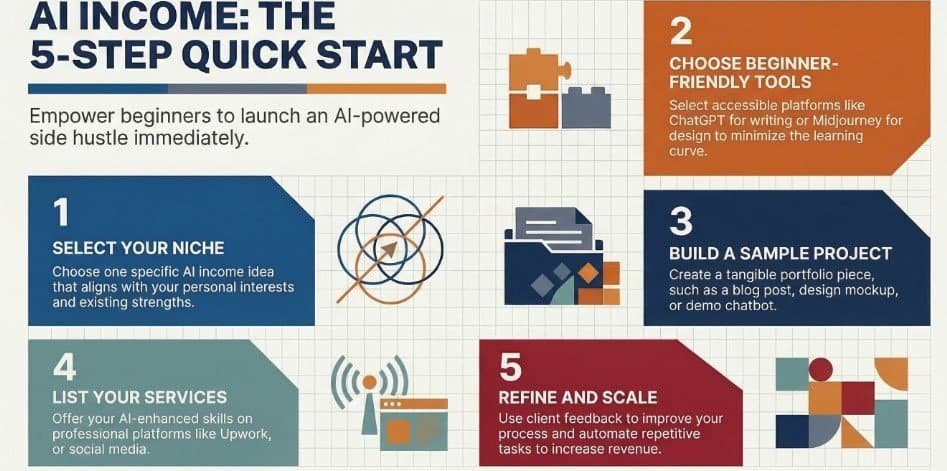
By focusing on one niche, you’ll build confidence, showcase real results, and attract your first paying clients quickly.
Frequently Asked Questions
Can beginners really make money with AI?
Yes. AI tools reduce technical barriers, allowing beginners to offer services like content creation, design, or automation without coding expertise. Success depends on leveraging AI effectively and providing genuine value.
What is the easiest AI side hustle?
Many find AI-enhanced freelance writing the easiest starting point. With a subscription to ChatGPT or Gemini, you can produce draft content quickly and focus on editing and client communication.
How much money can AI side hustles make?
Earnings vary widely. Freelancers might charge $25–$75 per article, designers earn $100–$300 per custom asset, and chatbot services can generate $500–$2,000 per month in recurring fees.
Do I need coding skills?
Not for most beginner AI side hustles. No-code and low-code platforms enable website building, chatbot creation, and Micro-SaaS development without programming knowledge.
Are AI-generated products legal?
Generally yes, but always review each AI tool’s terms of service regarding commercial use. Some free versions prohibit monetization, so upgrade to a paid plan or commercial license when necessary.
Conclusion
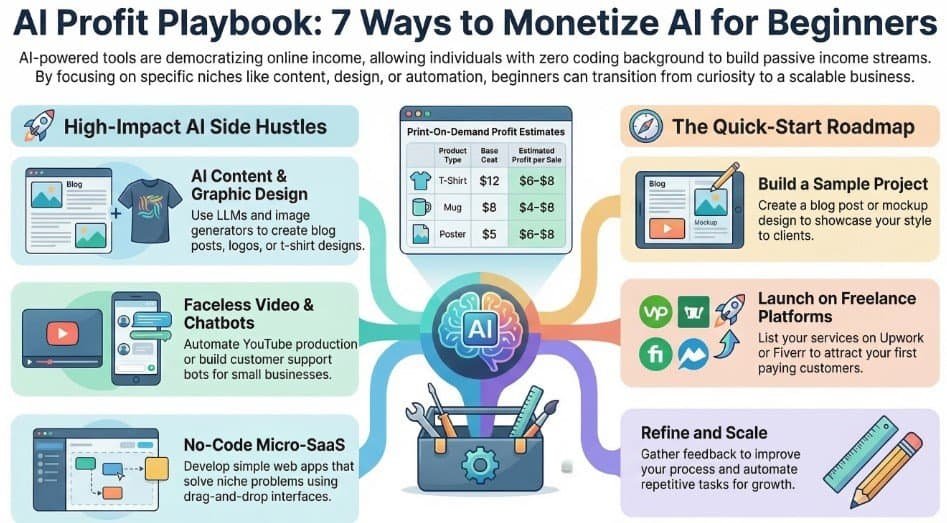
AI in 2026 offers unprecedented opportunities for online income, side hustles, and scalable digital businesses—even for beginners. From crafting blog posts with ChatGPT to launching Micro-SaaS apps on Bubble, you can match your interests to accessible AI tools. Start small, showcase your results, and watch your AI-driven side hustle grow into a sustainable revenue stream.
The future of work is AI-enhanced. By taking these first steps today, you position yourself at the forefront of a digital gold rush.
Reference List
- Coursera Staff. “How to Make Money Using AI in 2026.” Coursera, Dec 4, 2025. https://www.coursera.org/articles/how-to-make-money-using-ai
- Shopify Editorial Staff. “How To Make Money With AI: 19 Ideas (2026).” Shopify Blog, Oct 17, 2025. https://www.shopify.com/blog/how-to-make-money-using-ai
- Beebom. “How to Make Money with AI in 2026: A Practical Guide.” Beebom, 5 days ago. https://beebom.com/how-to-make-money-with-ai/
- TechTimes. “How to Make AI Video Income: Proven AI Content Monetization and Image Selling Methods.” Tech Times, Feb 6, 2026. https://www.techtimes.com/articles/314495/20260206/how-make-ai-video-income-proven-ai-content-monetization-image-selling-methods.htm
- Maria Ali. “10 AI Tools I Used to Create Income (What Actually Paid Me).” Medium, Feb 17, 2026. https://medium.com/@maryashoukataly/10-ai-tools-i-used-to-create-income-what-actually-paid-me-e2cd35eca229